

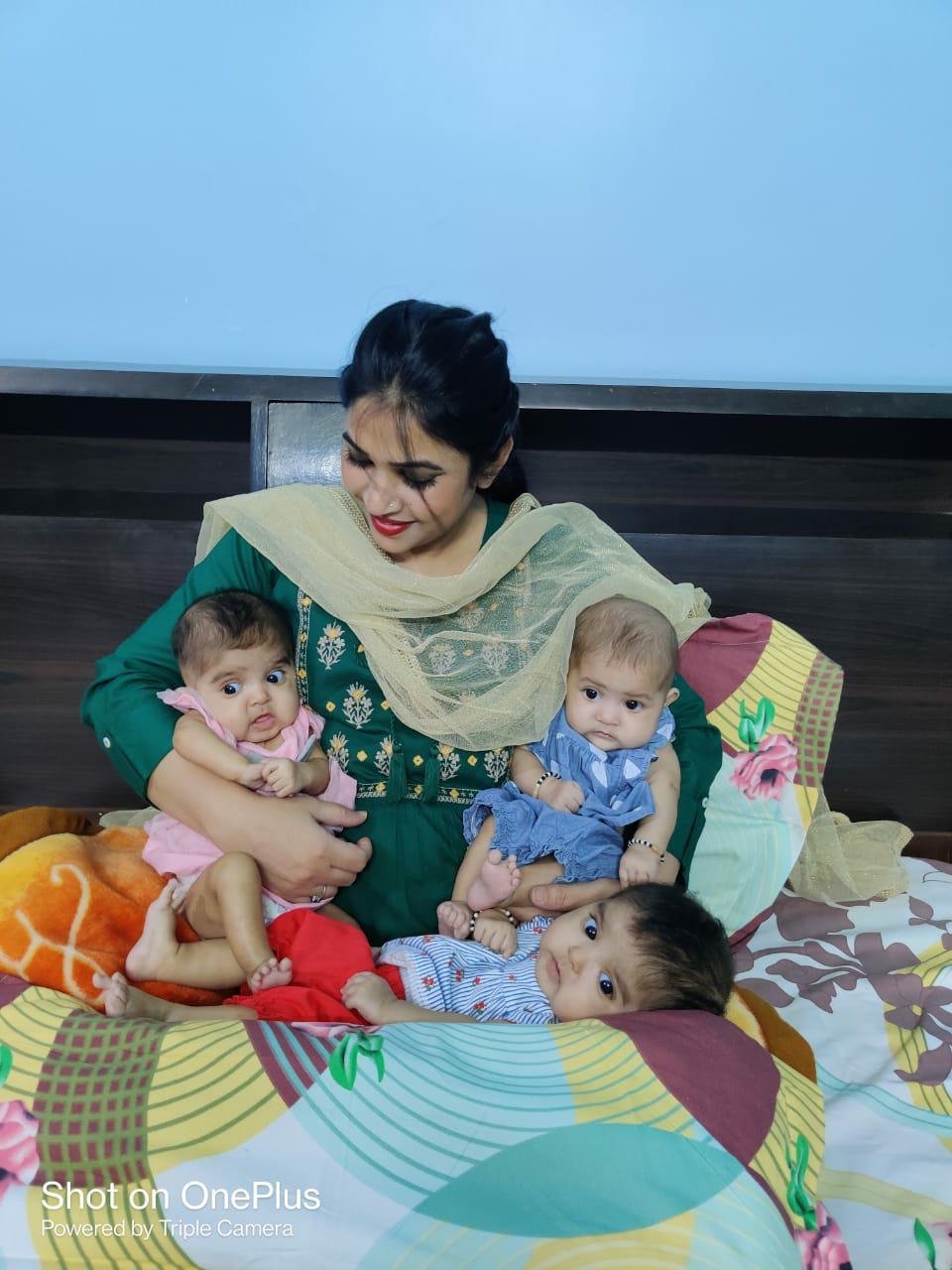
When doctors warned her that neither she nor her three premature daughters might survive, this mother chose to hold on to faith. After 28 days in the NICU and spending ₹8 lakh on treatment, she brought her babies home and cared for them against all odds.*
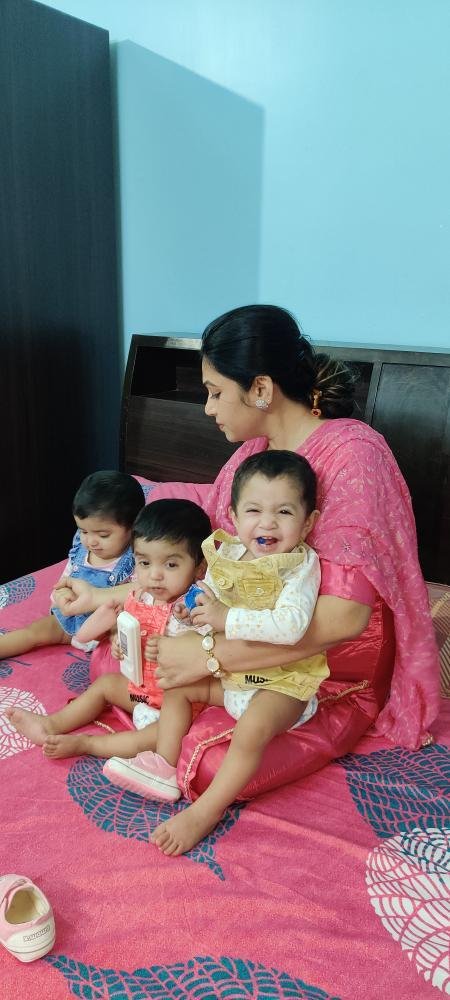
When she discovered she was pregnant with triplets, she never imagined that her pregnancy would become a fight for four lives: her own and those of her three unborn daughters.
Her pregnancy was naturally conceived, but the complications began early. Her oxygen levels had been dropping, and doctors feared that continuing the pregnancy could put her life at serious risk.
The warnings were frightening.
Doctors told her that neither she nor her babies might survive. She was referred to PGI because the doctors she first consulted in Prayagraj felt they could not manage her complicated condition. Termination of the pregnancy was discussed, but she was warned that even this could be dangerous.
At home, relatives and neighbours shared the same fears.
But she had another reason to be terrified.
She already had a two-and-a-half-year-old son.
Whenever she thought about him, she broke down crying. What would happen to her little boy if she did not survive? Who would take care of him?
She was being asked to make an incredibly difficult decision, with frightening possibilities on every side.
After thinking it through, she decided to continue the pregnancy.
She held on to her faith in Allah and hoped that somehow, all four of them would make it through.
## Her parents became her greatest source of strength
Throughout the pregnancy, her parents stood firmly beside her.
When doctors warned that the situation was life-threatening, they gave her the emotional strength to keep going. They supported her through hospital visits, cared for her at home and helped her navigate a situation that seemed impossible.
Their presence mattered even more as her health deteriorated.
Her oxygen levels had been low for months, and doctors worried that the strain of carrying three babies would make her breathing difficulties worse. The babies, too, faced the risks associated with being born very prematurely.
Eventually, her daughters were born at the beginning of the seventh month of pregnancy.
They were extremely small and needed intensive medical care.
Instead of bringing her babies home and beginning the usual journey of motherhood, she watched them being cared for in the Neonatal Intensive Care Unit (NICU).
She was about to face another battle.
## 28 days in the NICU — and ₹8 lakh already spent
The triplets spent 28 days in the NICU.
During this time, their weight decreased instead of increasing. Their condition remained a source of constant worry, and their mother was terrified that she might lose them.
She remembers seeing her babies in the NICU for the first time and breaking down in tears in front of everyone.
She feared they would not survive.
Holding her mother’s hand, she kept repeating one thing:
“Ammi, I won’t let anything happen to them.”
But the financial burden was becoming overwhelming.
The family had already spent approximately ₹8 lakh on their treatment, an amount they could no longer afford. According to the mother, the doctors had advised that the babies would need to remain in the NICU for several more months, potentially up to six months.
The family faced an unbearable situation: they wanted their daughters to receive all the medical care they needed, but they could no longer afford to continue paying for it.
Eventually, the babies were discharged.
The mother recalls being told that the babies were unlikely to survive if they were taken home in their condition.
She left the hospital frightened, carrying not just three fragile babies but also the weight of everything she had been warned might happen.
## She brought her daughters home and devoted herself to them
Taking her premature daughters home was not the end of her fear. It was the beginning of a different kind of struggle.
She was terrified that something might happen to them.
She remembers crying while bringing them home, more frightened than ever before.
She had been told that her babies might not survive. Now she had to care for them outside the NICU, knowing how vulnerable they were.
For the next six months, she devoted herself almost entirely to her daughters.
She stayed in a room with them, watching over them and focusing on their care. Her days and nights revolved around her babies.
Every small change mattered. Every day they remained stable brought another reason to hope.
Her parents supported her physically and emotionally throughout this period. They helped her day and night, giving her the strength to keep caring for her daughters even when she was exhausted and afraid.
When she felt overwhelmed, their presence reminded her that she was not alone.
And she kept going.
## From 1 kg to 6 kg in six months
The triplets had been born weighing approximately 1 kg each.
Over the next six months, their mother devoted herself to caring for them, and their weight eventually increased to around 6 kg.
For a mother who had been told that her babies might not survive, this progress meant everything.
The little girls she had feared losing were growing.
It had taken sleepless nights, constant attention, family support and a determination that never allowed her to stop trying.
But her own health was still fragile.
After this difficult period, she suffered a severe asthma attack. Her husband subsequently arranged a transfer so that he could be closer and help support the family.
She had spent months worrying about whether her daughters would survive, all while trying to protect her own health and care for her family.
It had been a journey of fear, faith, exhaustion and hope.
## The people who believed in her when she was afraid
Looking back, she says her parents played a crucial role in helping her survive this period.
Their support went beyond hospital visits. They were there when she cried, when she feared losing her babies and when she had to take on the enormous responsibility of caring for three premature newborns at home.
Their prayers, encouragement and practical help gave her the strength to continue.
She also credits her faith in Allah for helping her face the uncertainty.
When people around her feared the worst, she held on to the possibility that things might turn out differently.
Today, her story is one of a mother who faced frightening medical warnings, financial hardship and the uncertainty of raising three premature babies — and kept going through it all.
## When everyone feared the worst, she kept hoping
At the beginning of her pregnancy, she had been warned that neither she nor her daughters might survive.
She already had a young son waiting at home. She faced serious health complications, and her three daughters arrived months before their expected time.
Their NICU treatment cost approximately ₹8 lakh, and the family eventually had to bring them home because they could no longer afford to continue.
The next six months demanded almost everything she had.
Yet she continued caring for her daughters, supported by her parents and sustained by her faith.
Her journey is not a promise that every high-risk pregnancy will have the same outcome. Premature babies can require specialised medical care, and decisions about NICU discharge must be made with qualified medical professionals.
But her experience is a powerful reminder of what family support can mean when a mother is facing an overwhelming situation.
Sometimes, strength looks like making a difficult decision. Sometimes, it looks like asking for help. And sometimes, it is simply getting through another sleepless night while caring for the little lives that depend on you.
**She was told to prepare for the worst. Instead, she held on to hope, took one day at a time, and kept showing up for her daughters.**
And through those difficult months, her parents stood beside her, helping her find the strength to keep going.
This is her story of motherhood, faith and a family’s determination to hold on to hope.